
groups
What is the Optimal Team Time Trial Strategy?
If you are riding in a team online or in real life, how do you pick a team? How do you decide who rides first? How do you decide how long to pull for, and at what watts?
All these questions can be answered from nothing more than the rider’s FTP. That is because you can build a pretty good mathematical model of team strategy which will actually tell you how fast your current roster is compared with every other possible combination.
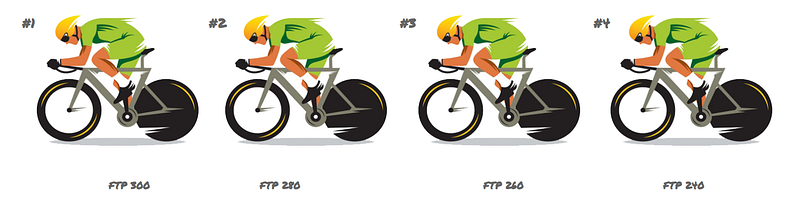
Today I will try to describe how this works. And it’s best to do this by starting at the back. Let’s use an example of four riders doing a two-hour team time trial.
In terms of order, I assume we can take for granted that the strongest rider always starts on the front. Why? Because once they get tired, they are the first to recover in the pack and then the first to re-pull at the front. You want to put the most demands on the strongest riders.
speed
Step 1: Watts to Avoid Being Dropped
The first step is to work out how fast the slowest rider can go whilst in the draft. It’s easier to just use “effective watts” rather than time, so we want to know how many effective watts (i.e. the watts you would need to go that speed if you were on the front) the weakest rider can output.
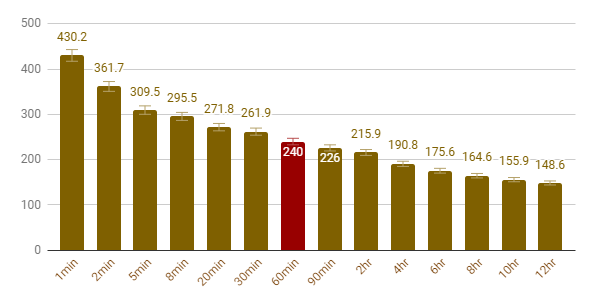
This is actually a little tricky, but if you use their predicted power curve from open_in_newfft.tips/curve, you can show that a typical FTP240 rider can sustain about 216w over two hours, so the team cannot go at a pace that exceeds an average of 216w for any rider 100% sheltering in the pack.
Next you need to adjust for the draft effect. You can get this from open_in_newfft.tips/draft or direct from Bert Blocken here:
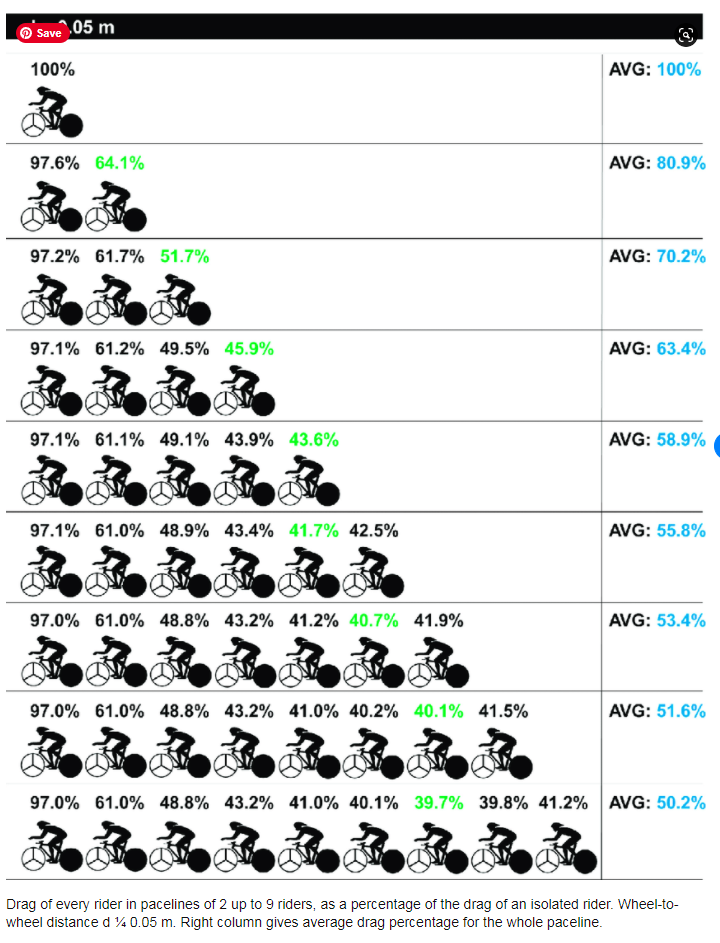
This is aerodynamic drag, not drivetrain or CRR drag, so it is not precisely talking about raw watts, and it’s dependent on team size (and wheel distance), but to keep it simple we can say you save roughly 150% raw watts in the pack versus the same speed on the front. For our example, this means that the team cannot go at a pace that exceeds an average of 324w for person #4, even if they don’t pull at the front.
timer
Step 2: Initial Pull at the Front
The next step is to work out how long each person can pull at 324w on the front. We can find this using trial and error from fft.tips/curve, but the time-to-exhaustion calculator will tell us precisely. It is the same as the time you can spend in ERG mode with the turbo trainer set to 324w.
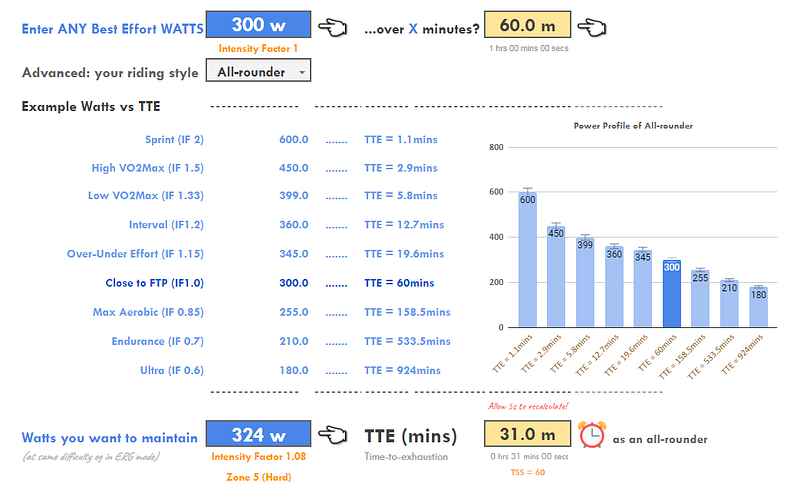
- For rider #1 the answer is 31m
- For rider #2 the answer is 20m
- For rider #3 the answer is 10m
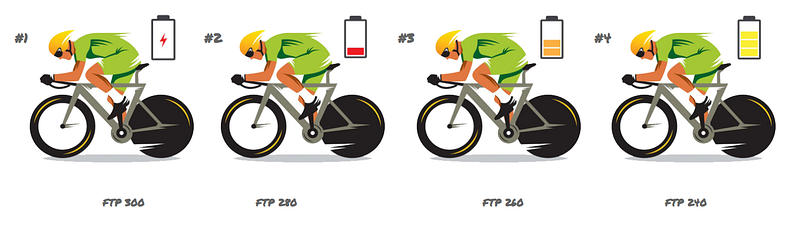
OK, so now we know that the three stronger riders can pull for 31m + 20m + 10m before needing to recover in the pack (or maybe give up). So this team as assembled could almost certainly ride 61m whilst pulling at 324w using the front three men. But we want a time of 2hrs/120m, so we need to add some team rotation, which will help recharge riders’ energy.
sync
Step 3: Pull Rotation Schedule
If we keep the same ratio of time at the front of 31:20:10:0 (or 3:2:1:0), then we can work backwards from 120m. We would need 60m from rider 1, 40m from rider 2, and 20m from rider 3. There are various ways to work out the number of rotations, but remember each rotation is an interval workout, with a near-maximal effort and then a (slight) recovery. In general, the more you divide the same amount of work into more intervals, the easier it gets, for example:
- 1×60 is harder than…
- 2×30 which is harder than…
- 3×20 which is harder than…
- 4×15min
But pulls of less than 1–2 minutes reduce the efficiency of the team because it takes a minute or so for the speed to stabilise, and each time a rider drops back they are riding solo (alongside the team) and have to catch back on, which is hazardous. For these reasons, in this case let’s peg the minimum pull at 2 minutes for rider #3. Therefore (if all riders take the same number of turns):
- Rider #3 needs to do 10× pulls @ 2 mins @ 324w
- Rider #2 needs to do 10× pulls @ 4 mins @ 324w
- Rider #1 needs to do 10× pulls @ 6 mins @ 324w
battery_charging_full
Step 4: Rotation Difficulty vs Recovery
We know rider #3 can ride flat out at threshold for 10m at 324w, but can they ride twice this (10×2 mins) at 324w? The good thing is that, using this schedule, they would get 4m + 6m in the pack after each pull, i.e. 10m of “recovery”, probably at zone 3 or “tempo”.
You can calculate the answer using W’ (W-prime), but I already made a calculator for this called the FFT Intervals Calculator (open_in_newfft.tips/difficulty), and this handy calculator says 321w would be more realistic than 324w. What about the other riders?
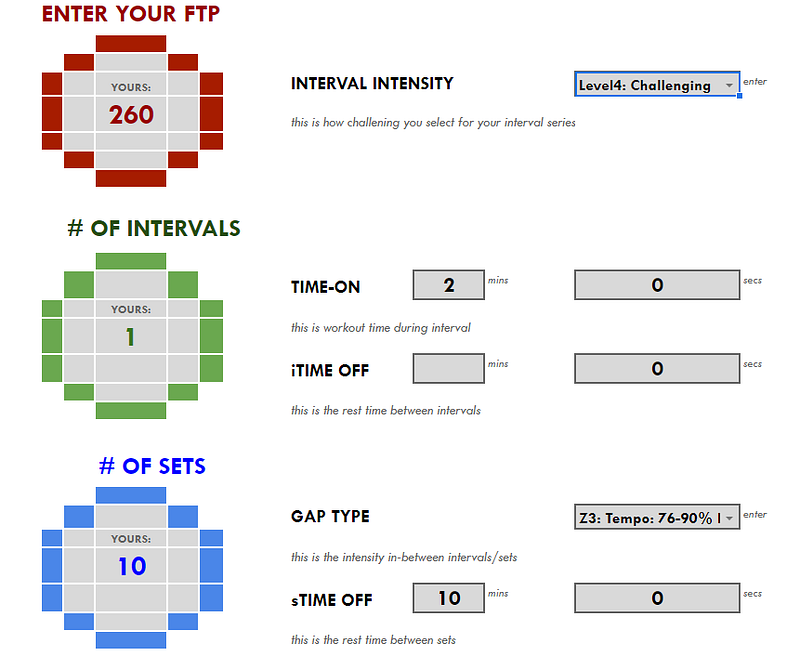
- Rider #3 can likely do 10× pulls @ 2 mins @ 321w
- Rider #2 can likely do 10× pulls @ 4 mins @ 307w
- Rider #1 can likely do 10× pulls @ 6 mins @ 309w
So all riders would have to throttle back their pulls accordingly, which is also good for rider #4, who would otherwise be at threshold the whole way. Indeed, they reduce to 206w (310/1.5), which they can maintain for 137 minutes.
calculate
Step 5: Average Effective Watts
Now we come to the overall effect. For this we simply have to average the watts of every rider’s contribution (at the front) in order to find the team’s effective watts, as follows:
(309 × 6) + (307 × 4) + (321 × 2) = 3724 / (6 + 4 + 2)
Sure, CdA and CRR would normally come in here, but we can make average assumptions, and that works out at 310w, or 41.3 kph on a flat course. Notice how, as a team, the mean FTP is 270w for 60 minutes, but actually the effective team watts is 310w over 120m. Not bad! This is mainly because the pull at the front is higher for everyone than their watts in the pack.
military_tech
Step 6: A More Rigorous Gold Standard
I have kept things simple in this example, and my quick manual calculation above gives a ballpark figure, but I have coded this more accurately in Google Sheets using a few more tricks and failsafes. Let’s check this “gold standard” against today’s result.
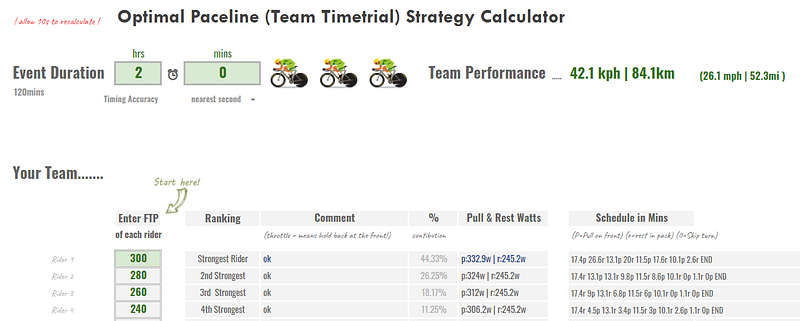
I said above 310w and 41.3 kph, but the calculator tells me that the true answer is 323w and 42.1 kph, and that’s because, with the watts of the team so close, person #4 should not have been excluded at the start – at least not unless their FTP is below 237w (when they would become a problem). However, this shorthand was not far off the right answer.
lightbulb
So Now You Know
- The optimal TTT strategy depends on riders’ ability and team composition/roster.
- Outliers (fast and slow) cause issues that must be adjusted for immediately to avoid drops.
- The front rider should always throttle their speed back for the slowest rider in the draft, but this is hard to do on the fly.
- Riders should pull until their power drops below the ability of the next rider to pull (i.e. not for as long as possible).
As this is a tricky calculation, our new calculator should give you the optimal strategy in any team event, track pursuit, team time trial, or Zwift TTT.
menu_book
Calculator Link
FFT Optimal Team Time Trial Calculator (Google Sheets) – https://docs.google.com/spreadsheets/d/1iDzn5JQ6SkoNjqwCqEH19E4QkMKzgbV2deeMKmjrkh0/edit?usp=sharing