
Previously I wrote about why HIT or HIIT training beats threshold and tempo work on a like-for-like basis. You can read that blog linkhere. I also explained why HIT has hidden benefits physiologically. That blog is linkhere.
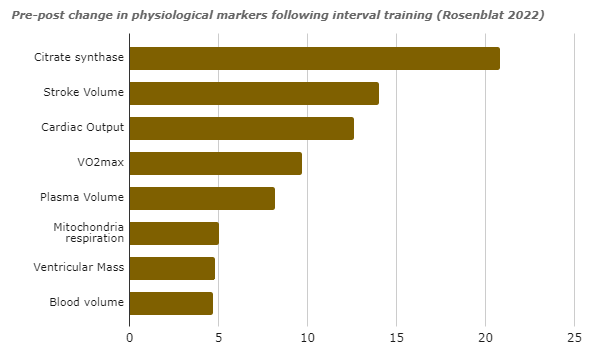
Today I am going to look at perfecting the interval session, digging into how long, how many, and how intense you should train for… and results appear to depend on whether you are doing SPRINT or VO2 max (HIIT) intervals:
- Sprints (SIT): e.g., 8 sprints per workout @ 30s on and 2 min off
- VO2 HIIT: e.g., 4 x 4 min VO2 max efforts with 2 mins rest
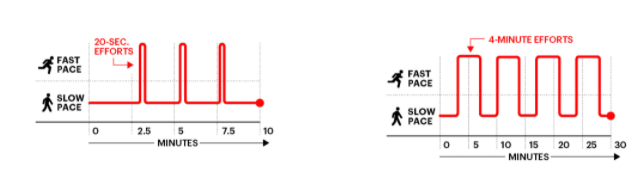
Recall that Seiler and colleagues compared the effects of three different formats of long intervals (4×4 min or 4×8 min or 4×16 min sessions with 2 mins rest) over 7 weeks (linklink).
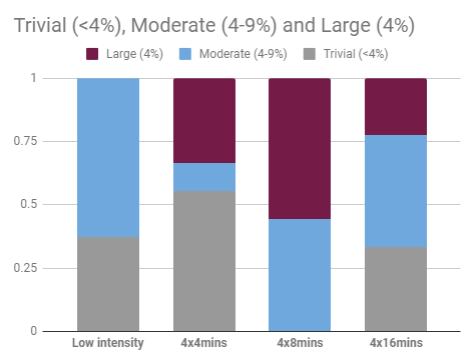
VO2 max improved by 10.4%, 6.5%, 5.6% and 3.4% in the 4×8, 4×16, 4×4 and low-intensity group, respectively; possibly with most improvement in the 4×8 mins.
However this was only one study, with the same number of intervals, same rest, and same duration… so we don’t know if these variables make a difference.
Since then a lot more data has appeared and been summarised in several meta-analyses by Rosenblat’s group as follows:
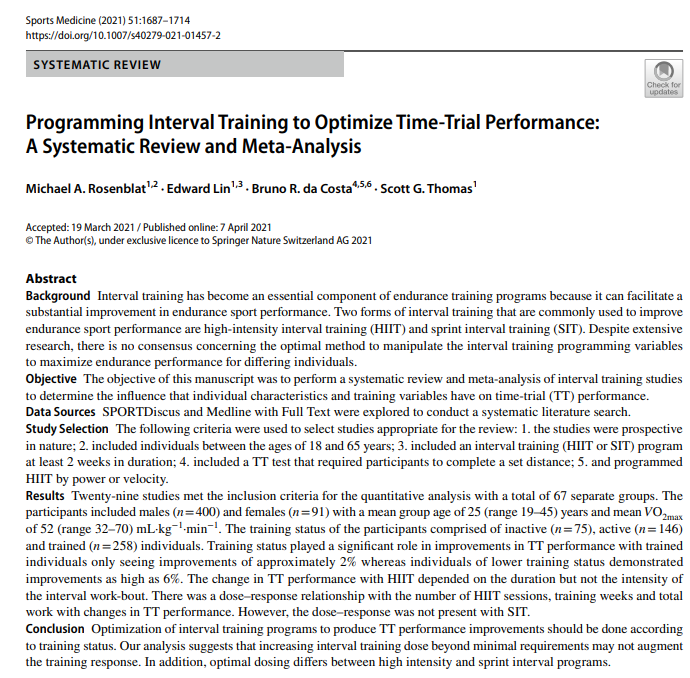
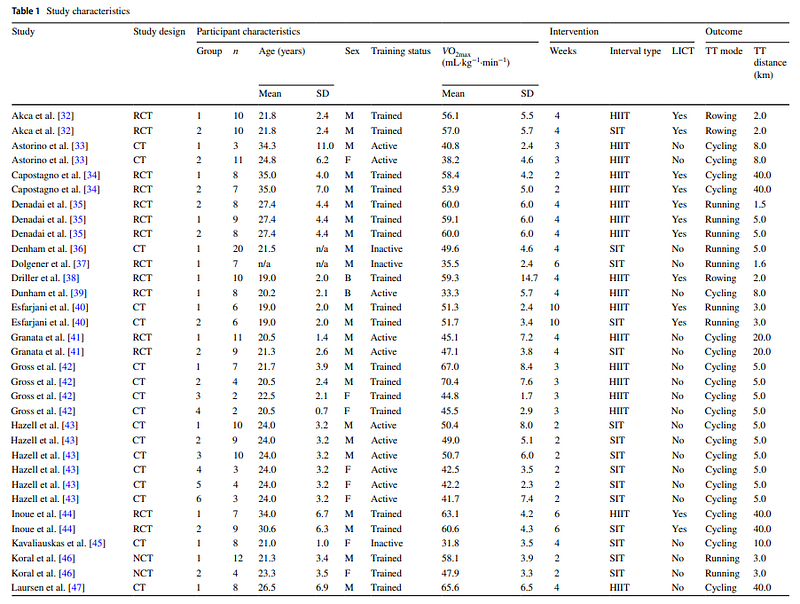
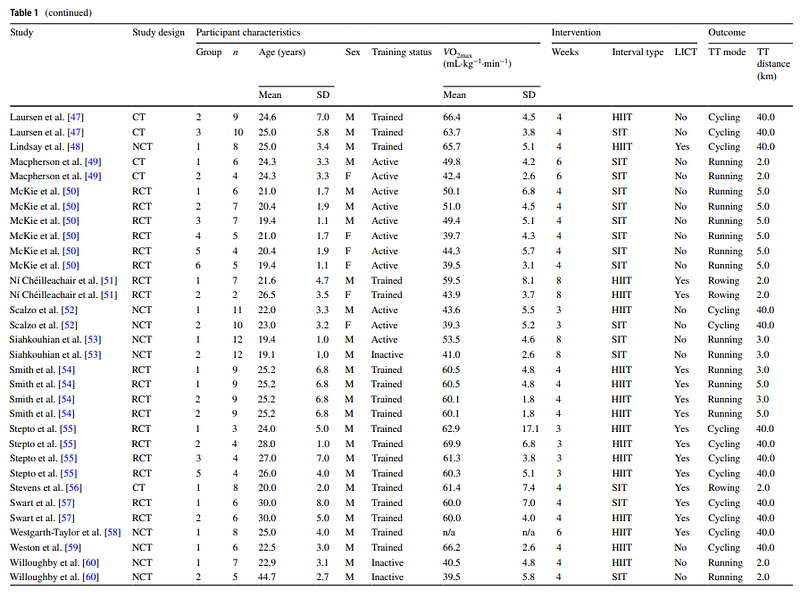
You can download the entire dataset here: linkDownload Dataset
But what does it show?
speed
Effect of Intensity
The first surprise from this data is for HIIT, then interval intensity itself did not have a significant effect (or any effect at all).
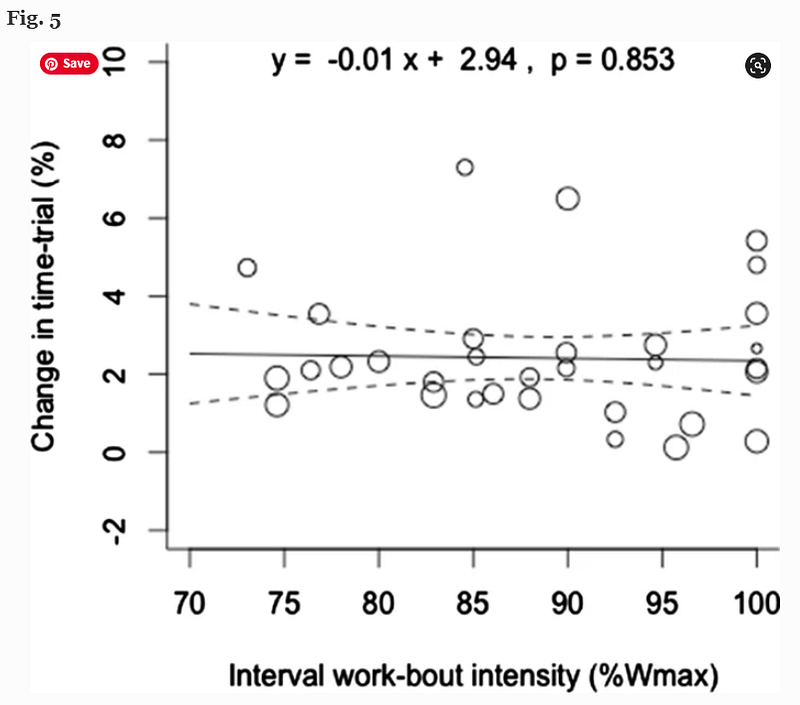
This might mean that anything over 75% of VO2 max is ok, or it might be that higher intensity is balanced by less duration. As SIT was performed at max intensity, it would be useful to compare HIT and SIT. Also, an older study by Helgerud et al. (2007) showed that HIIT at high intensity did induce greater effects on VO2 max than the same training volume at lower intensity, as did previous meta-analyses (Bacon, Carter, Ogle, & Joyner, 2013; Milanovic et al., 2015).
compare_arrows
What About HIIT vs SIT?
We looked at this before but now have additional data from at least 7 groups (Balto & Helgerud, 2019; Trane & Helgerud, 2018; Esfarjani & Laursen, 2007; Laursen et al., 2002; Lunt et al., 2014; Lee et al., 2017, Naves et al., 2018) who have directly compared HIIT and SIT on VO2 max. There is also a brand new meta-analysis by Boullosa (linklink) although they grouped HIIT with MICT/continuous.
Laursen et al. (2002) found HIIT to be significantly more effective than SIT at improving VO2 max (8.1% vs 3.0%) in trained cyclists.
Balto and Helgerud (2019) found HIIT to be significantly more effective compared to SIT (7.9% vs 1.6% change in VO2 max) in trained females. They also found threshold performance (3000m) improved by 5.7% after SIT and 5.7% after HIIT, and sprint (300m) improved by 5.1% after HIIT and by 6.4% after SIT.
The remainder found no difference between groups (Esfarjani & Laursen, 2007; Lunt et al., 2014; Trane and Helgerud, 2018) found no difference in VO2 max improvement between groups.
New data in the thesis of Anders Boye examined 23 trained athletes who did 10×30-second SIT or 4×4-minute HIIT for 3 days/wk for 8 wk. He found HIIT resulted in a significantly larger improvement in absolute VO2 max, compared to SIT (3.6% vs -0.5%, respectively) but SIT improved anaerobic capacity (9.5%).
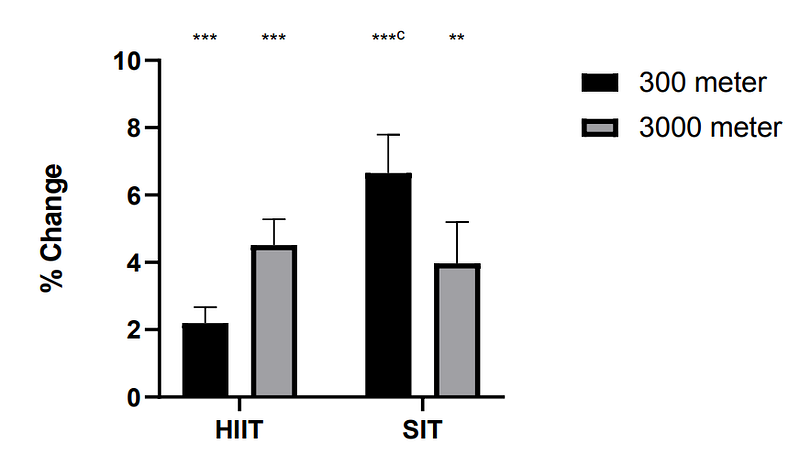
Further, both HIIT and SIT improved sprint and threshold performance, but SIT favoured sprints (6.7% vs 2.2%) and HIIT favoured threshold (4.3% vs 3.9%).
timer
Interval Duration
A second surprise from the Rosenblat data was there was no effect of interval duration on change in TT performance except in trained participants; in other words, any duration of interval training was beneficial in beginners, but sadly longer intervals may be needed in athletes.
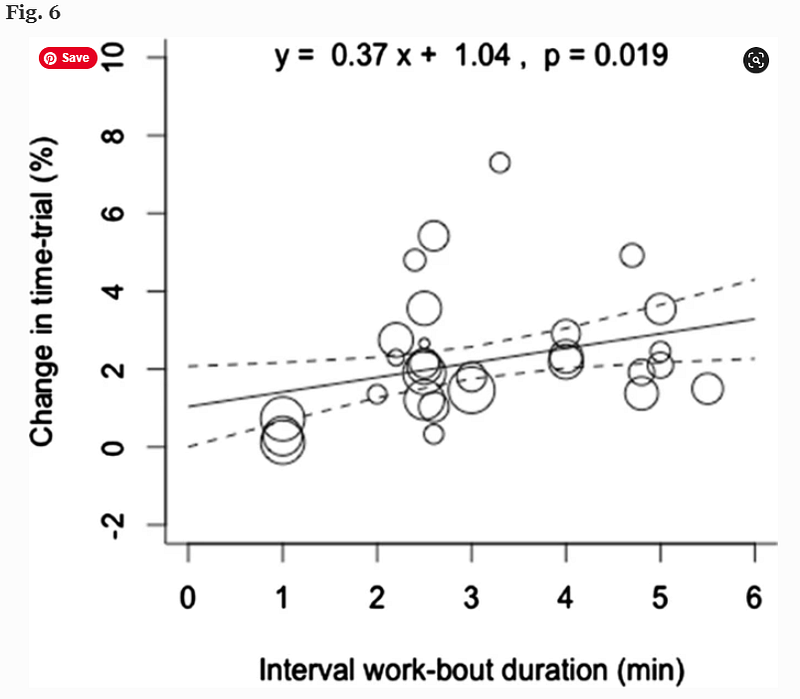
Recall that Seiler et al., 2013 found that a larger volume of HIIT, represented by 4×8-minute intervals (90% of HRmax) induced even greater effects on VO2 max than 4×4-minute intervals (but also more than 4×16 @ 88% of HRmax; so likely duration has a ceiling).
battery_charging_full
Recovery Periods
Active individuals demonstrated a greater improvement in TT performance following longer recovery; with optimal recovery duration equalling approximately 50% of the work-bout.
repeat
Interval Repetitions
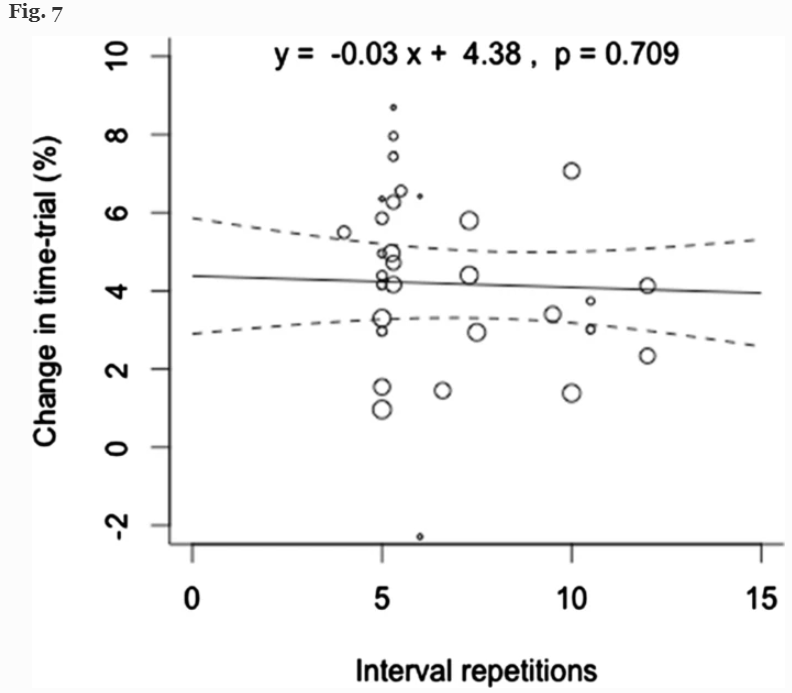
There was no effect of number of interval repetitions following SIT, but there was a slight decline in performance in trained individuals for more than five repetitions following HIIT.
calendar_month
Total Sessions / Sessions Per Week
There was a 1.5% greater improvement in TT performance when individuals performed three HIIT sessions per week compared to two sessions (but no effect in SIT).
The total number of HIIT sessions as well as number of HIIT training weeks had a strong influence on changes in TT performance, but again effects were not seen in SIT.
summarize
Summary
For beginners, any combination of HIIT or SIT is beneficial and effects will be quite large.
For trained individuals and athletes, somewhat longer HIIT with more workouts per week and longer plans are better but with appropriate rest.
Intensity of each session had a small effect and seems to depend on purpose. HIIT resulted in significantly larger improvement in aerobic capacity and VO2 max, but SIT preferentially improved anaerobic capacity (9.5%). Similarly for performance, HIIT benefits threshold work and SIT benefits sprint work, but both are effective.
recommend
Practical Recommendations
For beginners, start with a HIIT or SIT plan which starts relatively easy and builds very gradually because burn-out (or loss of motivation) is a major concern.
For trained individuals, start with a HIIT or SIT plan which starts moderately because injury is a major concern, but the plan should have reasonable volume and adequate rest.
- Beginners HIIT: e.g., 3 x 3 min VO2 max efforts with 2 mins rest, twice a week for 6 weeks.
- Intermediate HIIT: e.g., 4 x 4 min VO2 max efforts with 2 mins rest, two times a week for 8 weeks.
- Advanced HIIT: e.g., 5 x 5 min VO2 max efforts with 2.5 mins rest, 2–3 times a week for 12 weeks.
- Beginners SIT: 4 sprints @ 30s on and 4 min off twice a week for 6 weeks.
- Intermediate SIT: 6 sprints @ 30s on and 3 min off twice a week for 8 weeks.
- Advanced SIT: 8 sprints @ 30s on and 2 min off 2–3 times a week for 12 weeks.
calculate
Use Our Calculator
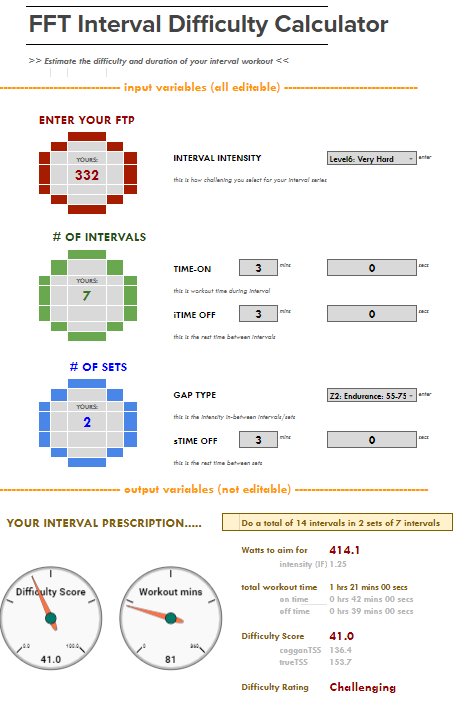
You can work out exactly what to do using our calculator (linklink).
menu_book
Citations and Further Reading
Rosenblat, M.A., Lin, E., da Costa, B.R. et al. Programming Interval Training to Optimize Time-Trial Performance: A Systematic Review and Meta-Analysis. Sports Med 51, 1687–1714 (2021)
Rosenblat MA et al. Effect of Interval Training on the Factors Influencing Maximal Oxygen Consumption: A Systematic Review and Meta-Analysis. Sports Med. 2022 Jan 18. Epub ahead of print. PMID: 35041180.
Anders Johan Nesheim Boye. Aerobic High-Intensity Interval Training Improve VO2 max More Than Sprint Interval Training. Master’s thesis in Exercise Physiology. Supervisor: Jan Helgerud, June 2020.
Balto, B. V. Y., & Helgerud, J. (2019). High-Intensive Interval Training or Supramaximal Interval Training — What to Choose When the Goal Is to Improve VO2 max and Aerobic Endurance Performance in Females. THESIS
Boullosa D et al. Effects of short sprint interval training on aerobic and anaerobic indices: A systematic review and meta-analysis. Scand J Med Sci Sports. 2022 Jan 28. doi: 10.1111/sms.14133.
Vollaard, N. B. J., Metcalfe, R. S., & Williams, S. (2017). Effect of Number of Sprints in an SIT Session on Change in VO2 max: A Meta-analysis. Med Sci Sports Exerc, 49(6), 1147–1156. doi:10.1249/mss.0000000000001204