
It is incredibly easy to mess up your race day nutrition. The typical advice you read online (e.g. 120g/hr–144g/hr carbs) is very unrealistic for most people and often influenced by nutrition companies. These peak concentrations are also usually not required because you carry huge fuel reserves in your body.
Sure, if you are unprepared (aka inadequately trained) you can easily run low on energy during a long event… but you can easily consume too much! So there is a tricky balance between too little and too much race-day fuel. For this reason, I am going to do a quick explainer in order to get the basics right. But first consider this real life story:
Sharon Gayter smashed the world record for 7 days non-stop on a treadmill and covering an amazing 833km. Over the event she couldn’t consume high carbs of 60g/90g/120g per hour due to GI distress. In fact her average was only 22g/hr!
This led to a massive energy deficit of 21,000 kcal… but surprisingly no weight loss. Why? Her oxidation of CHO, fat, and lactate were adequate enough to maintain blood glucose for the majority of the event. Read about her story linkhere.
Of her total calories, 65% were from CHO, 14% from protein, and 21% from fat. Fluids were 3.6L/day. Sodium intake was 4577mg/day.
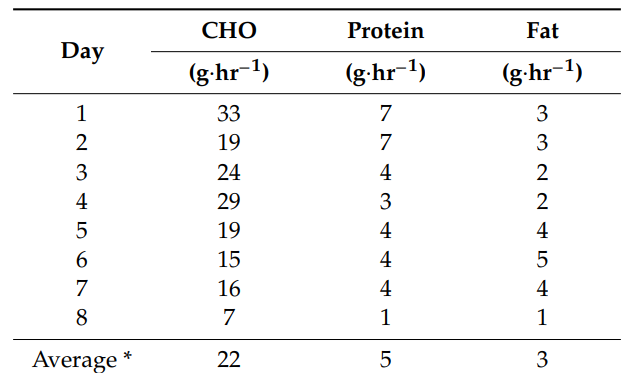
What this says is even in ultra events your body is an amazing resource and you do not always need high CHO supplements. But I would say the key message is:
It is better to finish on adequate nutrition, than to give up with GI distress on excellent nutrition.
Let me break this down into common race day errors in nutrition.
warning Error #1: Maxing Out Ingested CHOs
We are used to seeing discussions of max absorption rates. For example, recommendations for long endurance might be to consume up to 90g/h of multiple carbohydrates and 120g/h is possible in elite mountain-marathon runners linkViribay et al., 2020. 144 g/h has been reported to give carbohydrate oxidation of 105 g/h. However, none of this means these rates are correct for you!
Consumption should be lower when you are a newbie, when you are running (vs cycling), in very long or very short events, and when your intensity is relatively modest. This is why this figure is a little misleading:
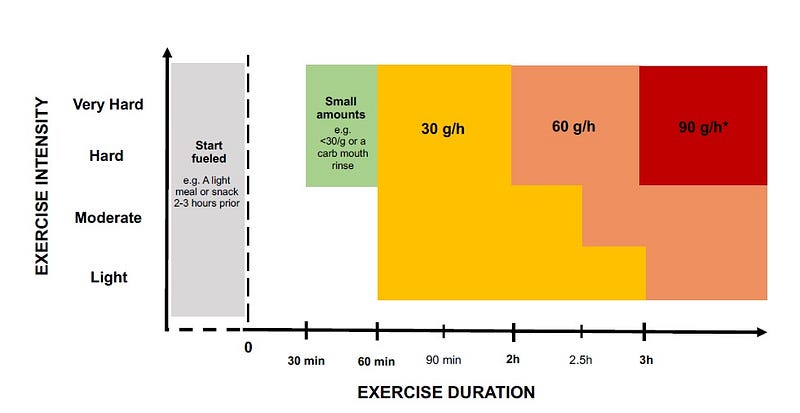
Meanwhile in the real world (outside the lab) 18 amateur ultra-endurance runners averaged just 33g/h in their events linkKinrade, 2021. If you assume you can tolerate more than 60g/h without trialling this in training, you are likely to have problems on race-day.
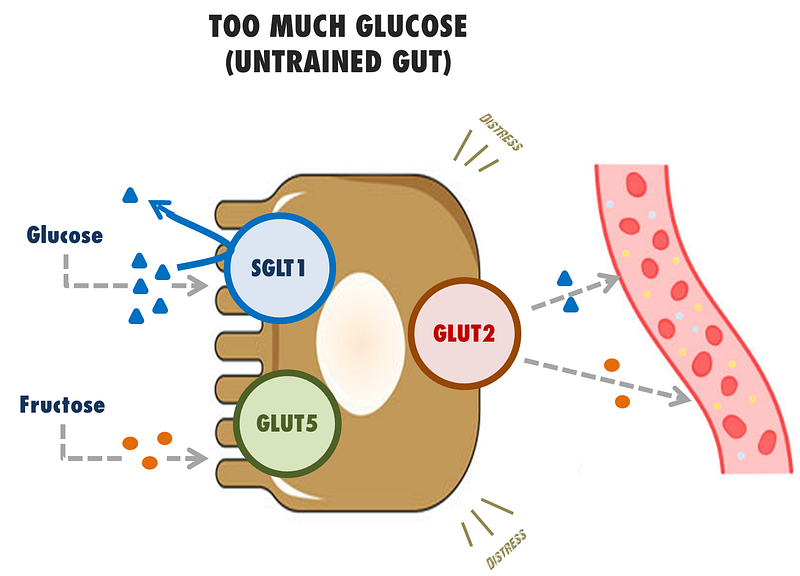
A new meta-analysis of 96 studies found CHO > 100g/h had a worse effect on athletic performance than lower concentrations linkBourdas et al., 2021.
restaurant_menu Error #2: Eating a New Diet on Race Day
Compounding error #1 above, athletes might chase high carb intake using bars, gels, and drinks that they are not used to. Often these products are highly refined, with minimal fibre or protein and the result is GI distress: aka bloating, gas, diarrhoea. Whilst it is true protein might slow the utilisation of carbs, that is not always a bad thing. In a long event you often need sustained fuels, not just quick hits of carb gels.

This is worse again if you have not *slowly adapted* to your race day fuel by doing training days with your race day nutrition! The lesson here is not to buy special foods on race-day… use the same foods you are already used to!

science Error #3: Relying on Glucose Alone
If you want to step your fuelling up above 60g/h, you will max out your glucose transporter (it is called SGLT1). If you *must* boost your carbs further then you have to rely on multiple types of carbohydrates such as fructose. Fructose is transported by GLUT5. Here is the longer version linkLINK.

BUT If you are doing a very long event (e.g. over 4 hours) as muscle glycogen becomes low your body relies more on fats for fuels. Therefore the performance should depend less on glucose (or CHO in general) since the percentage of energy contribution of CHO will be low in comparison to fats. CHO supplements do not reduce muscle depletion!
In 13C-NMR isotopes studies ingesting carbohydrate during exercise does not prevent muscle glycogen breakdown (muscle glycogen is always “burned” during exercise at the necessary rate) — instead, carbohydrate feeding simply diverts blood glucose from liver glycogen. linkGonzalez et al., 2015 found neither glucose nor fructose carbohydrate was able to prevent the low muscle glycogen during exercise but either type of carbohydrate fully prevented liver glycogen depletion.
water_drop Error #4: Relying on Fructose Alone
There is a temptation to move towards fructose to improve absorption. But more is not always better. Yes, fructose will help in some situations but in a new massive review of 96 studies, linkBourdas suggests fructose is really only effective in 120min–240min events. And then they suggest a Glucose : Fructose ratio of 2:1.
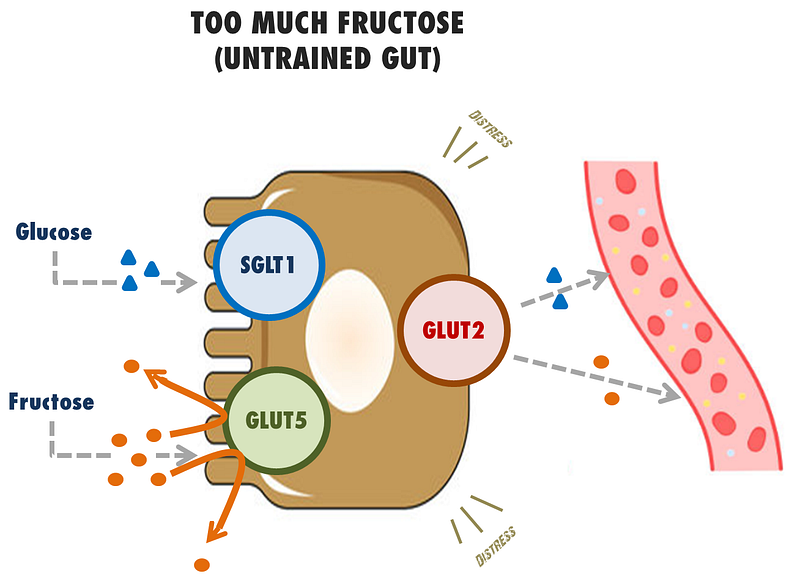
However, be careful because fructose (especially from artificial sources) is harder to metabolise and can itself cause GI distress. It is possible to have too much fructose as well. We suggest to avoid super high fructose foods (esp high fructose corn syrup).
Rule of thumb: Keep the fructose % to less than the glucose %
model_training Error #5: Forgetting “Gut Training”
Blood flow to central tissues (gut and liver) is reduced during exercise by around 80%, at 70% of VO2max linkQamar & Read, 1987. Both gastric emptying and nutrient absorption are dramatically reduced. This is exacerbated by dehydration.
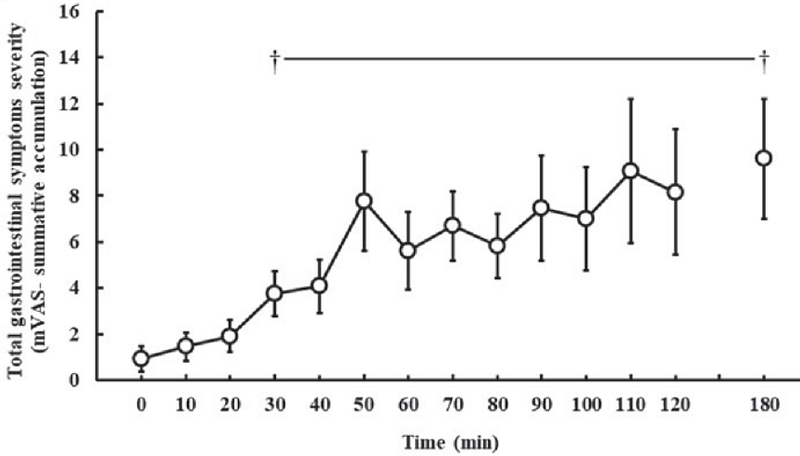
Severe gastrointestinal symptoms have been reported in 73%–85% of ultramarathon runners. Wardenaar et al. link6 and Costa et al. link8 found 82% and 65% had GI distress. In a new study of 25 endurance runners 60% had GI distress in 2 hr running at 60% V̇O2max linkLINK. linkRauch found high rates of distress in a 3hr running trial as follows (chart):
The gut can be “trained” by the gradual consumption of carbohydrates during exercise. This training will change your microbiome and your nutrient transporters. Training will help maximise the number and the performance of the SCGT1 transporters linkCosta, 2017 although this takes at least a few weeks.
However, don’t forget to do this at similar intensity as your race because exercise compromises intestinal carbohydrate transporters linkLang et al., 2006.
battery_charging_full Error #6: Forgetting to Pre-Load before a Race
Pre-load simply means building your normal bodily resources up. Nearly all the advantages of race-day fuelling are seen when pre-loading is poor. In other words pre-loading is as important or more important than race-day fuelling.
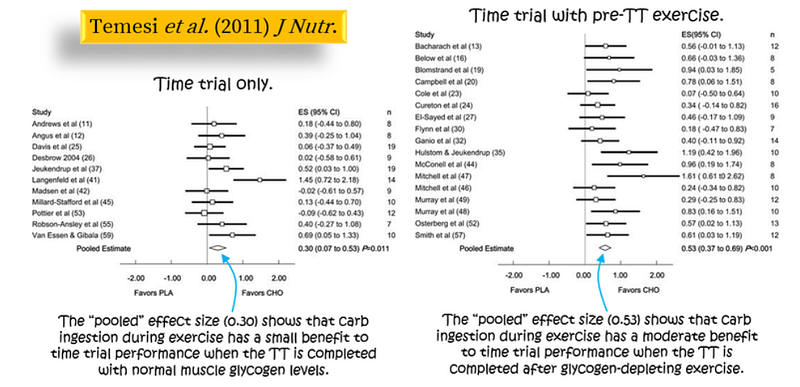
The 2011 meta-analysis from Temesi and colleagues found about a 2% linkbenefit of 30–80g/hr CHO with preloading vs 7% without preloading. In other words, preloading fills up your CHO stores so that you don’t need emergency top ups on the day. Without preloading, you will likely need fuelling during the race.
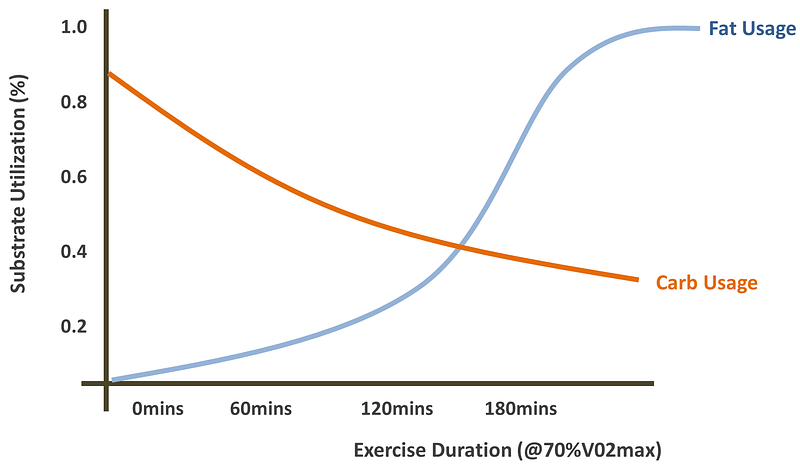
The liver can store about 100g of glycogen and muscle can contain approximately 400g. As each gram of glucose produces 4 kcals, 2,000 kcal can be obtained from liver carbohydrate storage i.e. enough for 2–3 hours aerobic exercise. Fat stores are much bigger. Fats are mainly stored in the adipose tissue and in a smaller amount in the muscle and each gram of fat produces 9kcal. Athletes can store an average of 12 kg of fat in the adipose tissue and muscle… up to 108,000 Kcal. This amount of energy will allow additionally 150 hours of exercise!
local_fire_department Error #7: Forgetting About Fat Oxidation
Training your “Fat oxidation” aka efficient fat use might be the secret to long events because it is incredibly hard to adequately fuel on exogenous carbs alone. Read my past blog here: https://www.cyclingapps.net/blog/myths-about-fatmax-weight-loss/
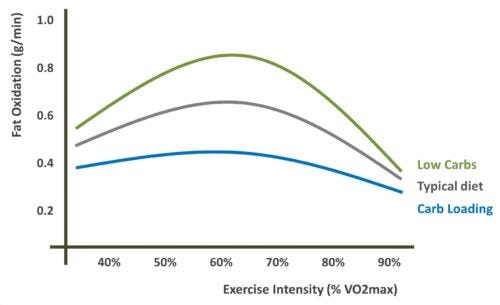
Low carb training, normal long-duration training sessions, or twice-a-day training is likely to result in frequently depleted muscle glycogen despite consuming a mixed macronutrient diet. With time these athletes have an ability to sustain high fat oxidation rates without the need for specific low-carbohydrate dietary interventions.
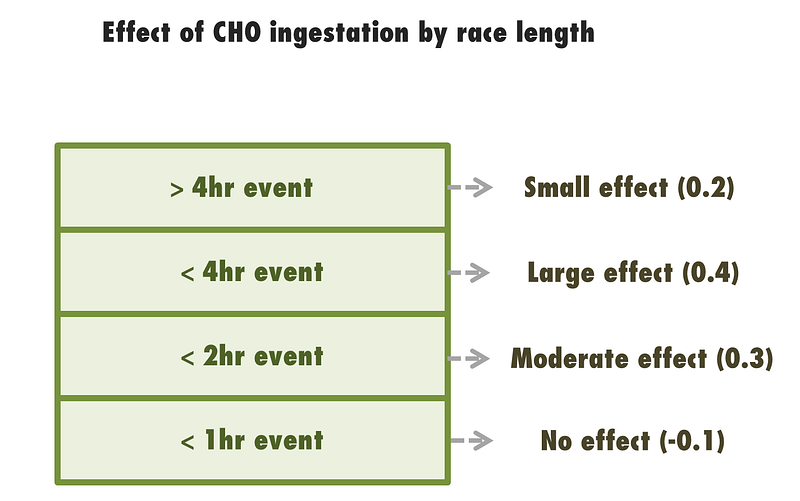
In the linkBourdas meta-analysis of 96 studies on CHO supplementation, the effect of CHO taken in-race was strongly related to event length:
error_outline Error #8: Inadequate Fuelling
Last, I must also mention inadequate fuel. Yes there is a link between low intake and poor performance (although it is weaker than you might expect). For example Kinrade 2021 linkref found this link between CHO intake and ultra-runners performance in 24hour race.
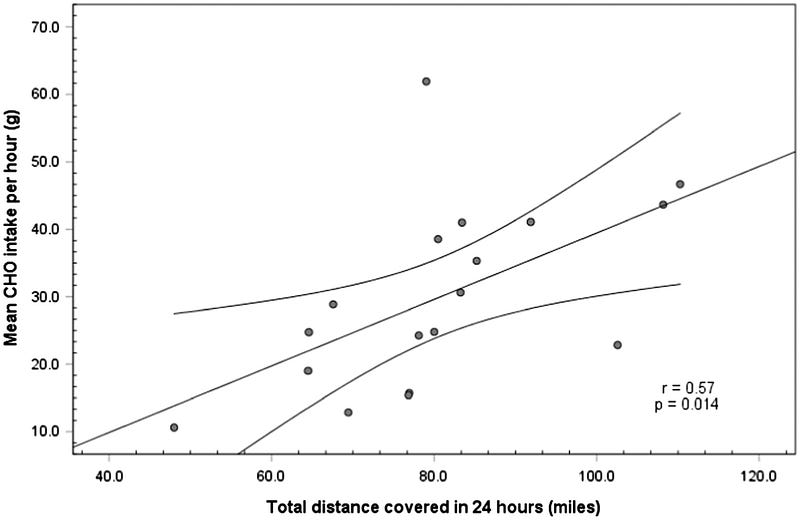
If you are racing longer than 2hrs AND fuelling less than 30g/h then you are likely to have a small disadvantage and you might run a risk of bonking.
How much disadvantage? Stellingwerf & Cox found a correlation of 0.35 between duration of event and carb-ingestion on race-day… for every 20mins there is a 1% gain in benefit.
emoji_events Successful Race Day Fuel Formula
Putting this together I would advise the following:
- Use pre-race fuelling > mid-race fuelling in events under 1hr.
- Start with 30g/h–60g/h in training, and build up slowly.
- Avoid an excess of carbs (e.g. >90g/h running, 120g/h cycling) unless “gut trained”.
- Use familiar foods (in my opinion, real foods are usually better than race products).
- Pre-load before race day (but again not to excess).
If you wish, try our race day fuel calculator.

menu_book Citations
Bourdas DI, Souglis A, Zacharakis ED, Geladas ND, Travlos AK. (2021).
Meta-Analysis of Carbohydrate Solution Intake during Prolonged Exercise in Adults: From the Last 45+ Years’ Perspective. Nutrients. 13(12):4223.
Burke LM, Castel LM, Casa DJ et al. (2019).
International Association of Athletics Federations Consensus Statement 2019: Nutrition for Athletics. Int J Sport Nutr Exerc Metab. 29(2);73–84.
Jeukendrup, A.E. (2017).
Training the Gut for Athletes. Sports Med 47: 101–110. [CrossRef]
Jeukendrup A. (2014).
A step towards personalized sports nutrition: carbohydrate intake during exercise. Sports Med 44(1);25–33.
Viribay A, Arribalzaga S, Mielgo-Ayuso J, Castañeda-Babarro, Seco-Calvo J, Urdampilleta A. (2020).
Effects of 120 g/h of Carbohydrates Intake during a Mountain Marathon on Exercise-Induced Muscle Damage in Elite Runners. Nutrients 12(5); 1367.
Costa RJS, Miall A, Khoo A, Rauch C, Snipe R, Camões-Costa V, Gibson P. (2017).
Gut-training: the impact of two weeks repetitive gut-challenge during exercise on gastrointestinal status, glucose availability, fuel kinetics, and running performance. Appl Physiol Nutr Metab, 42(5), 547–557.
Miall A, Khoo A, Rauch C, Snipe RMJ, Camões-Costa VL, Gibson PR, Costa RJS. (2018).
Two weeks of repetitive gut-challenge reduce exercise-associated gastrointestinal symptoms and malabsorption. Scand J Med Sci Sports, 28(2), 630–640.